

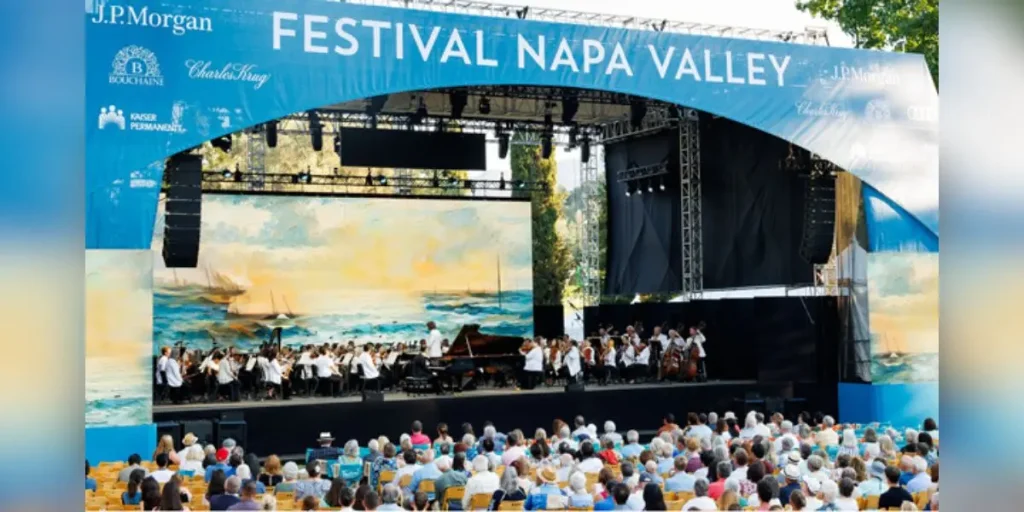
The 2025 Festival Napa Valley wrapped up its latest season with 63 performances across wineries and scenic outdoor stages, transforming California wine country into a celebration of classical music, jazz, opera and dance. From July 3–21, audiences enjoyed everything from orchestral concerts to film scores—each performance supported by Meyer Sound systems for consistent, high-quality sound.
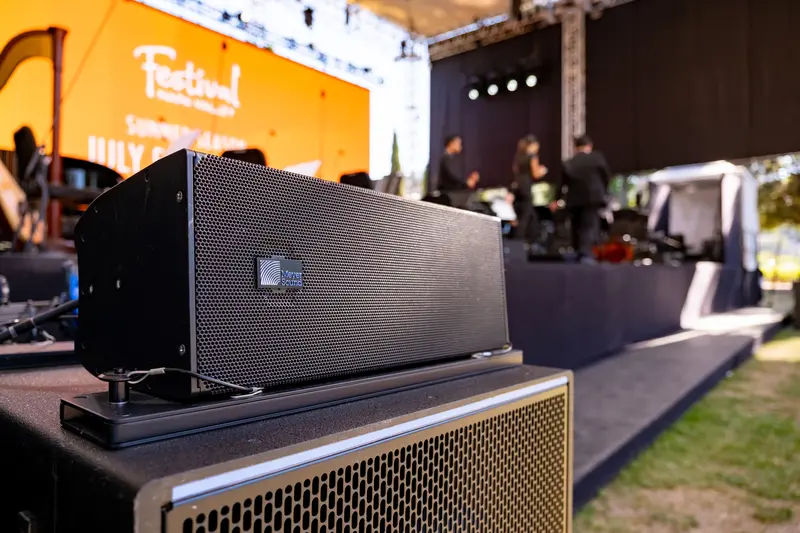
At the center of the festival is the main stage at Charles Krug Winery, where front-of-house engineer Brad Madix led system design and deployment with support from Sound Image, a Clair Global brand. The low-profile setup featured Meyer Sound’s LEOPARD compact linear line arrays and 2100-LFC low-frequency elements in a cardioid configuration. ULTRA-X20 loudspeakers handled front and out fill.
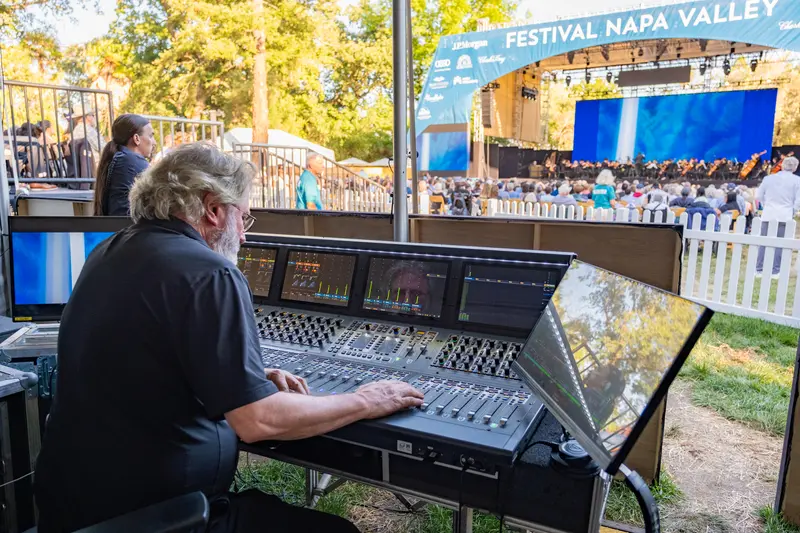
“We’re outdoors, in a flat field, with no reverberant space like you’d have in a concert hall,” he says. “We’re not trying to be loud here; we just need to project sound far enough for the back lawn while keeping things sounding natural for everyone in the seated area. The Meyer Sound system let us do exactly that. The result is even, high-fidelity coverage that feels true to the performance, no matter where you’re sitting.”
The team mixed at low levels, relying on open condenser microphones and careful system tuning to maintain clarity and avoid feedback. “We’re mixing quietly, with a lot of open condenser mics onstage, and still maintaining clarity and gain-before-feedback,” he adds. “It’s a sensitive environment, and this system lets us be precise without being invasive.”
That same focus extended to the musicians onstage. Executive producer Sienna Peck, a classically trained violinist, worked with Meyer Sound and Sound Image to rethink how amplified classical music could enhance, not hinder, live performance.
“I came to Festival Napa Valley as a player first, and when we moved from an acoustically treated hall to an outdoor stage, it completely changed the playing experience,” she explains. “This year we moved away from traditional wedges and adopted a distributed monitoring approach with ULTRA-X20s and ULTRA-X23s. The goal was to give musicians the feeling of being in a hall again—to help them trust their instincts and just make music.”
Peck said the new monitoring approach made the stage sound more cohesive and natural. “The musicians are so happy,” she continues. “We’re getting compliments from both the stage and the audience about the clarity and fidelity of the sound.”
That consistency proved essential as the festival hosted its most ambitious lineup yet. Events included the North American debut of France’s Versailles Royal Opera, a performance by the Pacific Symphony with pianist Tianxu An, a film series honoring Ennio Morricone, and a screening of Disney’s Fantasia accompanied by a live orchestra.
“We can have up to 100 musicians on stage some nights, and then pivot to a film score performance or ballet,” says Peck. “We need flexibility, fidelity, and consistency across genres and formats, and Meyer Sound delivers that.”
At the Arts for All Gala, held at Nickel & Nickel Winery, Grammy-winning artist Jon Batiste headlined the marquee event. The system there used ULTRA-X80 and ULTRA-X40 loudspeakers, along with 2100-LFC low-frequency elements. A ULTRA-X40 provided front-center down fill, while a pair of UPJ-1P loudspeakers handled side fills.
“His synth player hit some deep lows during soundcheck, and the whole tent just started vibrating,” recalls Peck. “It was one of those unforgettable live moments that reminded everyone what great sound can do.”
