

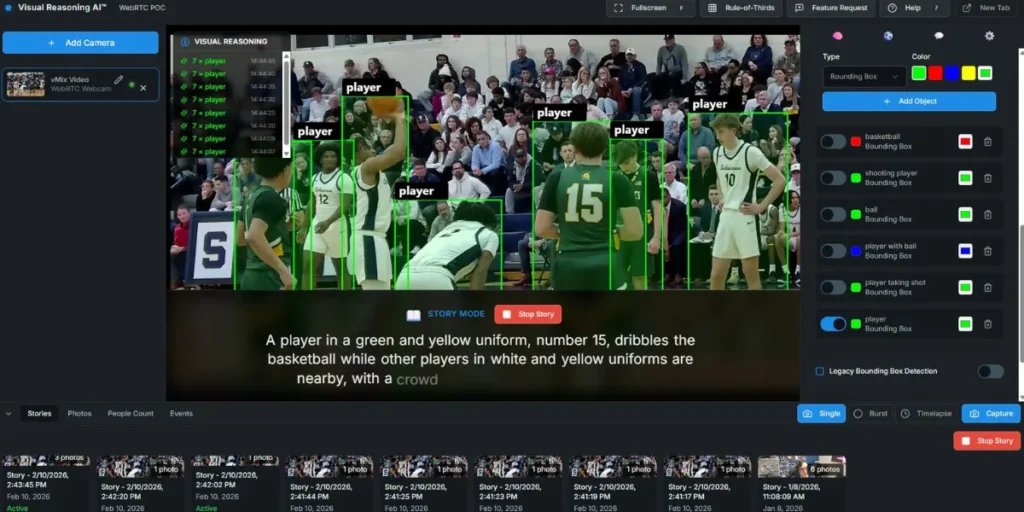
PTZOptics has launched its Visual Reasoning initiative, a new effort designed to make video more actionable by combining robotic PTZ cameras, AI and open integration.
The initiative is being developed in partnership with Moondream, a company focused on open-source vision language models that allow applications to interpret images and video. PTZOptics said the collaboration brings together its controllable PTZ camera systems with Moondream’s lightweight vision models to enable workflows that analyze what a camera sees and trigger actions such as automatic tracking, searchable video indexing and event-driven alerts.
“The Visual Reasoning concept of turning cameras into intelligent teammates and video into action is too important to be left to one company,” said Paul Richards, Chief Revenue Officer, PTZOptics. “We created this movement to help small teams deliver much bigger results, with fewer errors – whether producing local sports matches and corporate events or delivering critical monitoring work in factories and hospitals.”
Moondream provides the vision models that power the initiative. According to the company, its lightweight models are designed for fast visual analysis and have seen growing adoption across intelligent camera applications.
“The partnership with PTZOptics makes complete sense as Moondream’s North Star is to enable computers to reason visually in real-time,” said Jay Allen, Co-founder, Moondream. “PTZOptics has spent years making remote cameras reliable, controllable, and easy to deploy. The alignment of these cameras with our lightweight Visual AI solutions makes it now possible to deliver automated, practical decision making that is ready to play a major role in almost all industries.”
PTZOptics describes Visual Reasoning as a technology roadmap focused on combining AI with camera robotics to move video beyond passive capture. In this model, video becomes data that can be interpreted, counted and used to trigger automated workflows, camera movements or alerts.
The company said the concept expands on existing automated camera capabilities such as speaker or sports tracking by enabling systems to analyze scenes and generate actions in real time.
Several partners are already demonstrating the technology in different industries.
Axle AI is using Visual Reasoning to help media organizations search and manage large video libraries through automated tagging and indexing. Detect-It is applying the technology in manufacturing environments to identify defects and trigger alerts during production. LayerJot is exploring computer vision applications in surgical environments, including tools that analyze instrument usage and automate reporting workflows.
“Visual Reasoning becomes real when it connects to a workflow,” said Etay Gafni, Co-founder, LayerJot. “In high-stakes environments such as operating theaters, you need compliant, secure systems that can understand what’s on the operating table, what’s changed, and what action to take next.”
PTZOptics said the initiative is built around an open ecosystem and includes a set of guiding principles focused on responsible deployment, privacy and education.
As part of the effort, the company plans to release learning resources, tools and partner examples showing how Visual Reasoning can be applied across industries including education, healthcare, broadcast, houses of worship and industrial operations.
Developers and AV professionals can begin experimenting with the technology through an open-source Visual Reasoning project available on GitHub.
