

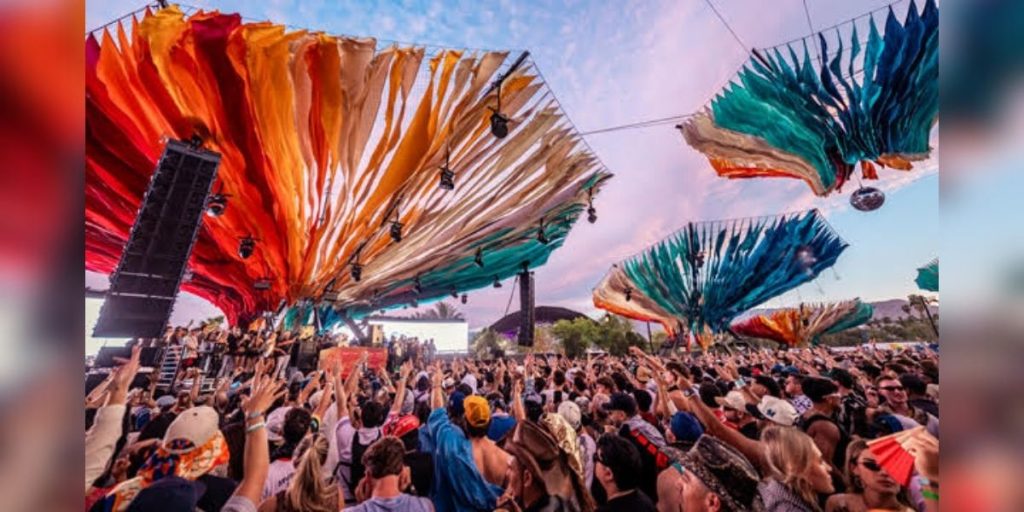
Meyer Sound’s new ULTRA-X80 point source loudspeaker made its Coachella debut in 2025 as part of an expanded system powering the festival’s Do LaB stage. The loudspeaker joined the PANTHER large-format linear line array and 2100-LFC low-frequency control elements to deliver coverage and clarity across a newly expanded audience area.
The system, provided by Los Angeles-based integrator Launch, supported performances from artists including Tycho, Max Styler, Conducta and Trixie Mattel. The Do LaB stage, located between the Sahara and Quasar stages on the Polo Field, featured the sculptural MACROdose canopy and drew some of the largest crowds in its history.
“Every year, we push to make the Do LaB experience more immersive, and Meyer Sound helps us realize that vision,” says Jesse Flemming, co-founder of Do LaB. “With the new system refinements, the sound was on point for every set, from front to back—and the crowd could feel it.”
The expanded system included 10 PANTHER-L loudspeakers per side, four PANTHER-W front fills, and 18 2100-LFCs in an end-fire configuration to manage low-frequency energy and minimize spill into nearby stages. Two ULTRA-X40™ and two ULTRA‑X80 loudspeakers were deployed for perimeter coverage. Two ULTRA‑X80 loudspeakers and four 900-LFC™ low-frequency control elements served as DJ booth fills.
“The new location gave us more flexibility to do what we really wanted: Extend low-end coverage and maximize clarity across a broader area,” says Josh Dorn-Fehrmann, senior technical support at Meyer Sound. “PANTHER and 2100-LFC are a perfect pairing for this kind of music and environment. Together, they basically sound like one giant loudspeaker. Because the horn is so well behaved, especially off-axis, we’re able to paint the space with sound really precisely—even across a super wide-coverage area like this one. We call it ‘audio quilting,’ stitching one speaker’s coverage into the next, sewing them together for seamless horizontal coverage.”
The coverage improvements helped reshape the audience experience, adds Dorn-Fehrmann. “The system’s even front-to-back relationship meant people didn’t have to squeeze forward to feel immersed. We couldn’t fly the subs, but the end-fire configuration let us push low end deep into the crowd.”
According to Do LaB systems engineer Ian Ingram, the results were clear. “PANTHER is just so present—it doesn’t feel like it’s falling off at front of house,” he says. “And the 2100-LFCs are fast, controlled, and deep. I had people telling me this was the best-sounding stage at Coachella, hands down.”
Ingram also noted how the system supported confident performances. “I was amazed at how loud some of the DJs were pushing their mixes,” he says. “It just shows how confident they felt with the setup. They weren’t fighting bleed from other stages—they were fully in the zone.”
That consistency laid the groundwork for even more sonic possibilities ahead. “That’s a priority we’re continuing to refine,” says Dorn-Fehrmann. “This year was about refinement—making sure every corner of the audience could experience the same great sound. Next year, we hope to build on that with spatial tools that add another dimension.”
“At Do LaB, we’re constantly evolving the stage—visually, structurally, and sonically,” says Flemming. “Working with Meyer Sound lets us push creative boundaries while still delivering consistent, high-quality sound every time.”
