

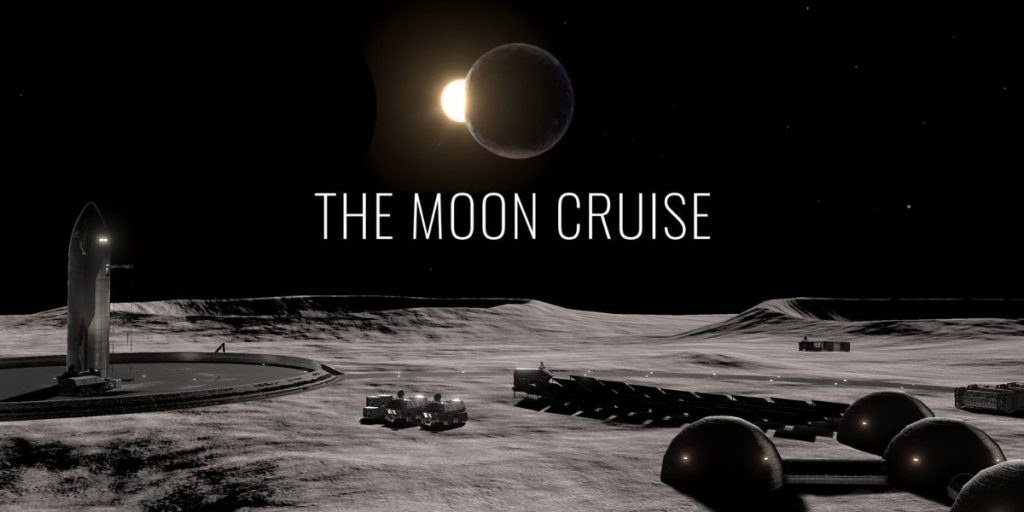
Powersoft’s Mover tactile transducers and amplifier solutions are powering an immersive lunar journey in Tokyo, where a permanent VR exhibit called THE MOON CRUISE brings visitors to the surface of the moon.
Installed inside Space Travelium TeNQ, a space-themed educational and entertainment facility, the free-roaming VR experience launched to the public on Nov. 22. It allows guests to simulate a rocket launch, walk on the moon, and download souvenir photos.
“THE MOON CRUISE” is a free-roaming VR experience permanently installed in a new space experience facility themed around ‘space travel’ called ‘Space Travelium TeNQ”. The space entertainment facility has permanent and special exhibits, as well as workshops to provide visitors with a single world-view learning experience,” says Tsuyoshi Nomura, executive officer at STYLY Inc., in charge of designing the experience.
Here’s a video of the install:
STYLY Inc. was tasked with an ambitious brief to create a VR experience that simulates the universe, all within the existing architecture. “The area we oversaw is permanently installed, free-roaming (walking around) VR experience. There are many event-style virtual reality environments, but nothing like this has been permanently installed on such a large scale,” says Nomura.
Integrated by Audio Visual Communications Ltd., the installation simulates a rocket launch and a lunar exploration. “It transforms limited physical space into boundless virtual environments,” says Ken Yamada, deputy general manager at Audio Visual Communications Ltd. “The rocket launch scene, powered by Powersoft Mover transducers and the Quattrocanali and Duecanali amplifiers, combines sound vibration and VR visuals for an unforgettable sensory experience.”
“Our goal was to provide a realistic experience and surprise visitors,” says Yamada. However, creating a convincing rocket launch experience in a confined and low-maintenance environment originally posed some challenges. According to Nomura, traditional large-scale motion platforms were impractical due to their size, maintenance requirements and safety concerns. “It was necessary to take a different approach, and we achieved both goals by designing new, easy-to-maintain fixtures and combining them with Mover.”
Powersoft’s compact Mover is a patented low-frequency direct-drive/tactile transducer adaptable for various purposes. It lets audiences feel the sound through haptic perception by vibrating the surrounding environment, which the human body picks up, and through bone conduction, that stimulates the inner ear, translating the vibrations into perceivable frequencies. Yamada explains that the “Mover’s compact design, flexibility, ease of installation, and impressive power,” made it the ideal solution for this installation.
The centerpiece of the experience is Powersoft’s Mover transducer, a compact haptic solution designed to convert audio signals into vibrations. Five Mover ID units are embedded beneath custom bench seating in the rocket launch area to deliver synchronized low-frequency effects. The transducers are driven by Powersoft’s Quattrocanali 1204 DSP and Duecanali 804 DSP amplifiers, provided by Audiobrains, Powersoft’s Japanese distributor.
For the content design, Nomura emphasised the importance of the journey visitors take on foot to their destination. “The narrative centres around travelling to the moon, focusing particularly on the path to the lunar surface. By emphasising the impact and experience at the departure point, it makes the visual-only walking on the lunar surface afterward feel more realistic. Since the entire facility provides a learning experience, the content encourages the visitors to reflect and act independently, rather than only focusing on the story,” he explains. He adds that this approach provides an experience that truly feels like visitors are exploring space and taking action.
The collaboration between STYLY Inc. and Audio Visual Communications Ltd. was integral to the project’s success. According to Yamada, initial tests showed that Mover provided stronger vibration from bone-conduction effects than competitor products. Additionally, the ability to apply sub-harmonics with the Quattrocanali and Duecanali amplifiers was appealing, allowing for the reproduction of the ultra-low frequencies, necessary for rocket reproduction, without the need for additional equipment.”
“Vibration and sound are not separable,” adds Nomura. “During an actual rocket launch, unimaginable vibrations and energy from the loud noise would impact the body. Mover, which vibrates with the sound source and transmits vibrations in sync with the powerful sounds that are linked with the visuals, makes it possible to create an experience that feels as if you are actually launching into space.”
Nomura concludes: “With Mover we were able to provide the best experience possible and combined with the content design, we achieved our client’s initial request.” From liftoff to moon landing, THE MOON CRUISE offers a gravity-defying experience and brings the thrill of space travel within arm’s reach of the visitors.
