

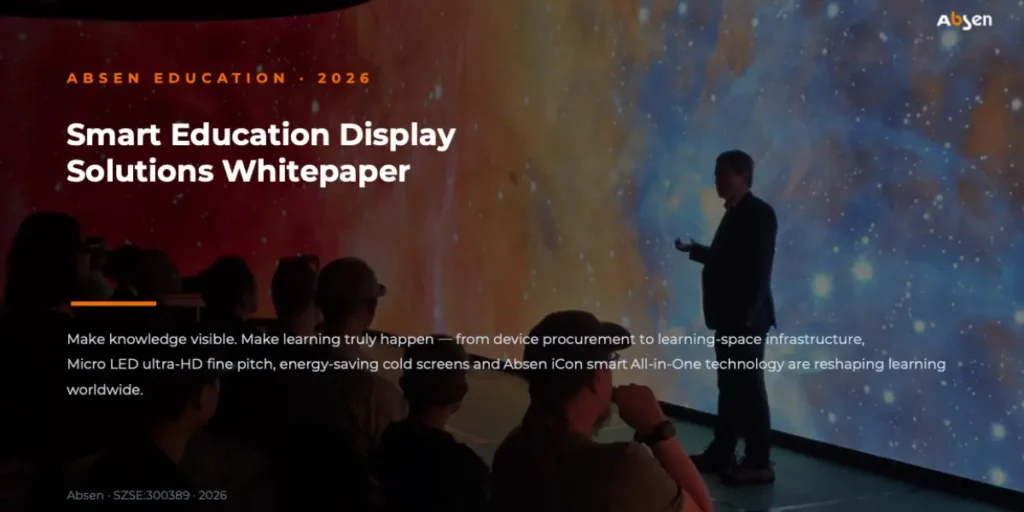
Absen released its Smart Education Display Solutions White Paper, examining how display technology is evolving to support hybrid learning, centralized campus management and sustainability goals. The report identifies five key capabilities for evaluating educational displays and explores their applications across six types of learning environments.
The white paper identifies four factors influencing classroom display requirements: hybrid and flexible instruction, centralized technology management, visual health and campus sustainability initiatives. One of its key takeaways is that institutions should evaluate displays as part of their broader learning-space infrastructure rather than as standalone equipment, considering factors such as system integration, energy efficiency and long-term reliability.
The report also compares laser projection, interactive flat panels and MicroLED technology, finding that each is suited to different educational environments. According to Absen, laser projection works well in large spaces with controlled lighting, while interactive flat panels are better suited to smaller classrooms requiring close-range interaction. For larger instructional spaces with challenging ambient lighting and frequent equipment use, the report identifies advantages for MicroLED in glare reduction, durability and maintenance.
Energy efficiency is another major consideration. Absen reports that its display technology can reduce energy consumption by 35% to 40% compared with conventional devices. Its calculations suggest that equipping 50 classrooms with 136-inch displays could save more than 150,000 kWh of electricity over five years. The white paper also highlights the importance of centralized management, with open APIs and compatibility across campus control systems, video conferencing platforms and learning management systems helping institutions manage displays across multiple spaces.
The report examines applications across classrooms, lecture halls, XR simulation spaces, hybrid seminar rooms, campus digital signage and multifunctional facilities. It also references deployments such as an immersive XR classroom at Webster University, reinforcing Absen’s emphasis on selecting display technology based on the specific needs of each learning environment.
