

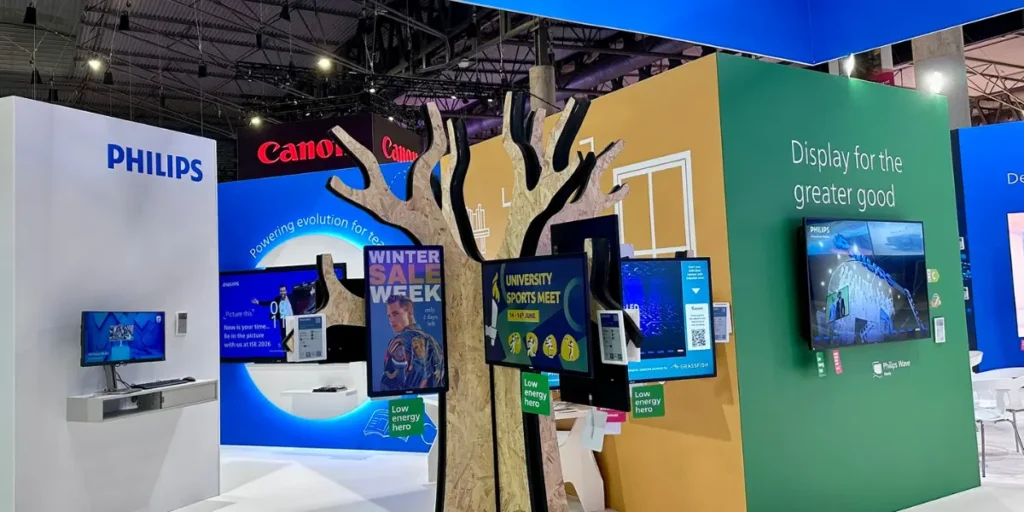
PPDS has announced a new sustainability framework called ReDesign, which the company says builds on lessons from its EcoDesign display program and is intended to guide the development of Philips Professional Displays.
According to PPDS, ReDesign expands the approach used with its Philips Signage 3000 Series EcoDesign displays to address sustainability and energy efficiency across the product life cycle. The company said the framework is designed to consider factors including product development, manufacturing, packaging, delivery, installation, remote management and end-of-life recycling.
PPDS said the framework is built around six principles: reduce, reuse, repair, refurbish, recycle and reinvent. The principles are intended to encourage the use of fewer materials and resources, longer product life cycles, easier repairs, refurbishment and greater use of recycled and bio-based materials.
PPDS said ReDesign will be progressively applied across its Philips Professional Displays portfolio. The company pointed to the Philips Signage 7000 Series, introduced at InfoComm 2026, along with the Philips Signage 5000 Series and Philips Signage 2000 Series, as examples of products associated with the approach.
PPDS also said ReDesign extends beyond display hardware to packaging and logistics. The company cited reduced packaging formats, recycled brown cardboard and efforts to eliminate most plastic from packaging as examples. It also said improvements in palletization are expected to contribute to an estimated annual reduction of 184 metric tons of tank-to-wheel carbon dioxide emissions while reducing wood use by approximately 107 metric tons annually.
The company said the ReDesign framework will be supported by TPV’s manufacturing network across Europe, the Americas, India, Asia-Pacific and China.
“ReDesign represents the next evolution of that journey,” said Andrea Barbuti, global product manager in EMEA for PPDS. “It builds on everything we have achieved and learnt through the creation of EcoDesign, applying those insights across our portfolio to create more sustainable products, reduce environmental impact, and help our customers achieve their own sustainability ambitions.”
