

Many K-12 teachers, school administrators and AV/IT tech managers have student safety constantly at the forefront of their minds. After all, these people are tasked with educating and protecting children as their full-time jobs. Also, safety has a range of meanings. Are all doors being secured? Is student information protected? How do we ensure that only authorized people can enter the building?
A couple of months ago, I attended the Summer Summit on School Safety, organized by Safe and Sound Schools and the Partner Alliance for Safer Schools (PASS), where these questions and many others were discussed.
Rethinking School Safety With Michele Gay
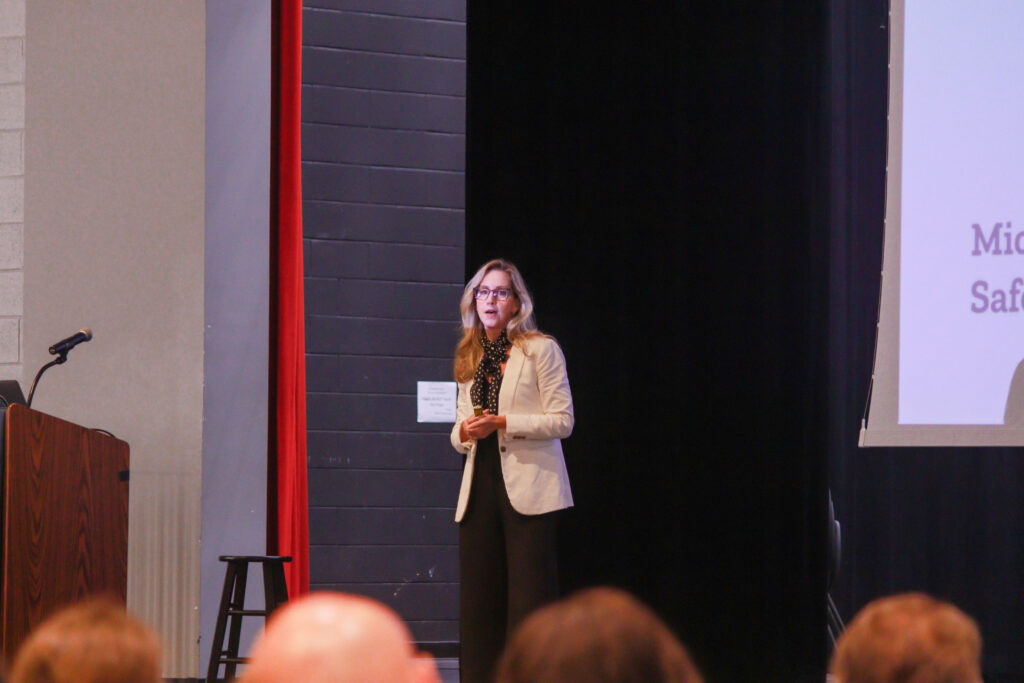
The conference started with a keynote from Michele Gay, co-founder of Safe and Sound Schools. Gay’s daughter, Josephine Gay, was killed in the 2012 Sandy Hook Elementary School shooting. Michele Gay shared her family’s story, reflected on the events of that day and explained how the experience shaped her mission to help schools better protect students.
With that mission in mind, she co-founded Safe and Sound Schools to create a meaningful legacy for her daughter. The organization’s goal is to make sure every child in every school is safe. To work toward that goal, Gay explained that her organization had to look at school safety differently.
Part of that shift came from what she witnessed in the aftermath of the Sandy Hook shooting. She realized that she was surrounded by people in her area who cared deeply about kids and her community. These people came alongside her and joined in taking on the difficult work of recovering her school community.
One night, she thought to herself, “What if all of these amazing people had all been together before the crisis? How much different would today be?”
These questions helped shape the way she approaches school safety.
Michele Gay has since spoken at many different events. She said she never thought of herself as someone with any expertise to offer, but that people wanted to hear from her. As Gay has visited more and more schools and communities, she said she has seen excitement and relief in what she is doing and with whom she is doing it.
Gay concluded that she didn’t have to know everything; she just needed to know the people who understood what mattered.
That idea became an important part of her approach to school safety. Gay embraced the expertise of the people around her and has since built a team that reaches communities all across the U.S. Through education, training and resources, Safe and Sound Schools has reached 32,000 schools, and that work continues today.
Safe AI Implementation with Antoinette King
In the next session of the day, Antoinette King talked about how AI can impact all parts of school communities.
Her session discussed the types of AI, the risks every school district must manage and the framework she suggests for all learning environments.
King emphasized throughout her presentation that there must always be a human element when using AI, especially in learning environments. The biggest question she poses to all school districts is who owns the decision? Who will be the one to decide which AI products their district uses and how they are used?

Her solution is something she calls the S.A.F.E framework.
The “S” in S.A.F.E. stands for Safeguard Data and Privacy. For K-12 tech managers, that means knowing exactly what information is being collected, shared and possibly exposed. For example, if any teacher uses the free version of Canva for lesson plans or student reports, all of that content and data is being exposed to train its AI model. Without realizing it, a teacher could be sharing a student’s entire behavioral history with AI.
The “A” means Analyzing Impact and Risk. If the AI gets something wrong, how will it impact the school?
“F” stands for Formalize Governance & Accountability. AI may inform decisions in your school district, but humans must remain accountable for them. From teachers to IT managers and even the lunch team, King challenged school districts to include someone from every area to make these decisions.
Lastly, “E” stands for Empower Through Education. This is a reminder that K-12 AV and IT tech managers have an incredible opportunity to educate teachers, administrators and staff on both the benefits and risks of AI.
Technology Supporting Safer Schools
Aside from the educational sessions, I also had the opportunity to learn more about the latest technologies that are helping schools respond more quickly during emergencies. I visited both Advanced Network Devices and AtlasIED’s booth. Advanced Network Devices demonstrated its threat detection technology, including how its solutions can suport emergency response:
They offer multiple school safety solutions, but their panic button stood out to me the most. When pressed, the button can automatically alert the school and initiate a lockdown. The button can be placed on a wall or installed in a more discreet location, such as under a desk.
When I visited AtlasIED’s booth, I learned about their mass notification system and how it can be used to communicate different types of alerts throughout a school.
The IPX series system can send different messages using various colors and flashing lights depending on the situation. The system also supports two-way communication, allowing staff to communicate through the device when needed. Additionally, all of these functions can be managed through a single interface.
What stood out to me was how much information schools can communicate through the system beyond just one alarm. In an emergency situation, the message students and staff need to receive can vary depending on what is happening and what action they need to take.
Special Session with Jim Crumbley: Risk Response Team
Technology plays a vital role in school safety, but what about solutions that don’t require multiple rounds of budget approval?
Jim Crumbley addresses exactly that during a special session on the PASS layers and components. He took us into a vestibule and walked through the practical ways school safety decision-makers can add additional layers of security before a visitor ever reaches the main entrance.
One example was the use of multiple intercoms. Rather than allowing a visitor to move through the vestibule before communicating with school staff, an intercom provides another checkpoint before they are given access to the building. Crumbley also showed how a single, strategically placed camera can provide a view of the entire vestibule.
One of the simplest solutions he discussed was also the one that stood out to me most: a box.
Students often forget things like lunches, backpacks and homework that need to be dropped off by their parents or other visitors. However, that doesn’t mean they should automatically gain access to the building. Crumbley suggested placing a simple drop-off box in the vestibule, where those items can be left without giving someone access beyond a secured entrance.
Schools can take this concept a step further with a bulletproof, impact-resistant glass window and a small opening where items can be passed through. But Crumbley’s point was that the solution doesn’t necessarily need to be complicated or expensive. Even something as simple as a box can prevent an unauthorized person from entering the school.
I’m incredibly grateful to have been part of this day. I think of my niece and nephew and how important it is to have people like Jim Crumbley, Michele Gay, Antoinette King and all of the school safety decision-makers across our nation, determined to keep our children safe.
I also think of AV and IT tech managers and the role they play in that mission. One of the biggest takeaways from this conference is that school safety comes in layers. There is no one-size-fits-all solution. It takes learning about the hidden threats of AI and educating teachers and staff on how to keep student information safe. It takes having the right technology in place so that when an emergency occurs, information can be communicated clearly and efficiently. It takes looking at spaces differently and asking what small changes could make it more secure.
However, most importantly, as we learned from Michele Gay, school safety takes a team. AV and IT tech managers know the systems, the spaces and the technology in their schools in ways others may not. But they don’t have to have the answer to everything. Bringing school administrators, teachers, staff and school resource officers together creates an opportunity for safety gaps to be closed and for solutions to be found that one person or department may have never considered.
